If you have ever repotted a monstera, pothos, or philodendron into a standard bag of potting mix and wondered why it still looks sad a few weeks later, you are not alone. Most plant parents assume soil is soil. But when it comes to aroids, that assumption is quietly killing their plants.
The truth is, aroids are a very specific family of plants with very specific needs. And the average potting mix sitting on the shelf at your local garden center? It was not designed with them in mind.
Let's break down what aroids actually need from their soil, why regular mixes fall short, and what a proper aroid soil mix looks like.
What Even Is an Aroid?
Before we get into soil, it helps to know what we're talking about. Aroids are plants from the Araceae family, and chances are, your home is already full of them. Monsterras, pothos, philodendrons, ZZ plants, peace lilies, anthuriums, and alocasias are all aroids.
They are some of the most popular indoor plants in the world right now, and for good reason.
They are relatively forgiving, grow fast when happy, and look incredible in any space.
But here is the thing: in the wild, aroids do not grow in dense, compact soil at all.
Where Aroids Actually Come From
Most aroids are native to tropical rainforests, particularly in Central and South America, Southeast Asia, and parts of Africa. In their natural habitat, they grow on the forest floor, on rocks, or as epiphytes, meaning they cling to the sides of trees and absorb nutrients from the air, rain, and whatever organic matter falls around them.
The "soil" they grow in naturally is loose, chunky, and full of air pockets. It drains fast, dries out between rains, and is rich in decomposed organic matter like bark, leaves, and wood. There is very little dense, compacted dirt involved.
This is why dropping your aroid into a standard potting mix, which is usually dense, moisture-retaining, and heavy, can cause so many problems.
The Problem With Regular Potting Mix for Aroids
Standard potting mixes are typically made for a broad range of plants. They are designed to hold moisture for longer periods, which works well for vegetables, flowering plants, and some herbs. But for aroids, that same moisture retention becomes a problem.
When aroid roots sit in wet, dense soil for too long, they cannot breathe. Aroids have thick, chunky roots that need airflow around them. Without it, the roots start to rot, and root rot is one of the most common reasons aroid plants decline and die indoors.
Signs your aroid is suffering in the wrong soil:
-
Yellowing leaves that are not caused by light or watering issues
-
Mushy or brown roots when you unpot the plant
-
Soil that stays wet for more than a week after watering
-
Slow or stalled growth even during the growing season
-
Leaves that droop even though the soil feels moist
If any of these sound familiar, the soil is likely the first thing to look at.
What Good Aroid Soil Actually Needs
A quality aroid soil mix needs to do a few specific things well. Here is what matters most:
-
Fast drainage
Water should move through the soil quickly and not pool at the bottom of the pot. This protects the roots from sitting in moisture and allows oxygen to reach them between waterings. -
Chunky, open structure
A proper aroid potting mix has a chunky, open texture, thick bark pieces, perlite, and coarse materials rather than fine, compact dirt. This is what people mean when they talk about a chunky aroid potting mix. The gaps between particles are where the roots breathe. -
Nutrient retention without compaction
Just because the mix drains fast does not mean it should be nutrient-poor. Good aroid soil holds onto the nutrients your plants need, nitrogen, phosphorus, and potassium, without becoming dense over time. -
Beneficial microbial activity
Healthy soil is alive. Mycorrhizae and other beneficial microbes form relationships with plant roots that help them absorb nutrients more efficiently. Most basic potting mixes have very little of this going on. -
No peat moss
Many commercial mixes rely heavily on peat moss as their base. Peat holds a lot of moisture, which, as we now know, is the opposite of what aroids want. Beyond that, peat moss is an environmentally damaging ingredient that takes thousands of years to form. There are far better alternatives.
What to Look for in a Ready-Made Aroid Mix
If you are shopping for an aroid soil mix rather than building one from scratch, here is what the ingredient list should look like:
-
Bark fines: for structure and aeration
-
Pumice or perlite: for drainage
-
Worm castings: for slow-release organic nutrients
-
Compost: for microbial life and organic matter
-
Biochar: for nutrient retention and aeration
-
Mycorrhizae: for root health and nutrient absorption
What it should not include: peat moss, synthetic fertilizers, or dense fillers that compact over time.
If you have been searching for aroid soil mix near me or browsing options online, the ingredient list is always more telling than the marketing on the front of the bag.
Also Read: Winter Houseplant Care Tips: How to Keep Your Plants Thriving Through the Cold Months
Monstera Soil - A Special Note
Monsteras deserve a mention here because it is one of the most popular aroids and also one of the most commonly potted in the wrong soil. Monstera soil needs to be well-draining and rich in organic matter, but it also needs to support the plant's large, fast-growing root system.
A chunky aroid potting mix works particularly well for monsteras because the open structure allows those thick aerial roots to move through the soil without compaction. If your monstera has stalled growth, yellowing leaves, or keeps getting root rot, switching to a proper monstera soil potting mix indoor formula is usually the fastest fix.
How Rosy Soil Approaches Aroid Soil
At Rosy Soil, every mix is built around the same core philosophy: soil should work the way nature intended, without the shortcuts that harm plants or the planet.
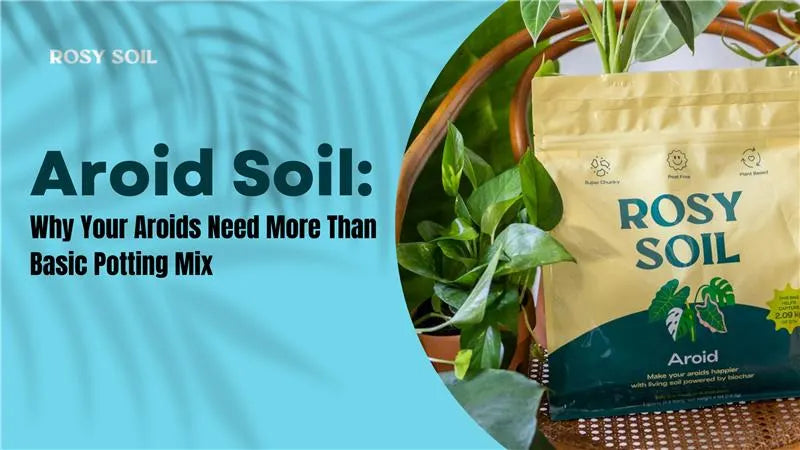
The Houseplant Soil is designed specifically with tropical aroids in mind. It uses biochar, mycorrhizae, worm castings, bark fines, compost, and perlite, no peat, no synthetics. The result is a chunky, well-draining, nutrient-rich indoor plant soil that gives aroids the environment they actually evolved to grow in.
It is also carbon negative, which means every bag actively removes carbon from the atmosphere. For plant parents who care about more than just their collection, that matters.
Prefer to shop in person? Use the Rosy Soil Store Locator to find a retailer near you carrying the Aroid Soil mix.
Conclusion
Aroids are not difficult plants; they just need the right environment. And the single biggest thing most indoor plant parents overlook is the soil.
A standard potting mix can keep an aroid alive, but it rarely helps it thrive. The right aroid soil mix, chunky, fast-draining, alive with microbes, and free from peat, is what actually unlocks the fast growth, deep green leaves, and strong roots that make these plants so satisfying to grow.
The science is clear. Your aroids are asking for better soil. The only question is whether you are ready to give it to them.
Want to find the perfect soil for every plant in your collection? Check out the Ultimate Plant & Soil Finder on the Rosy Soil blog.