


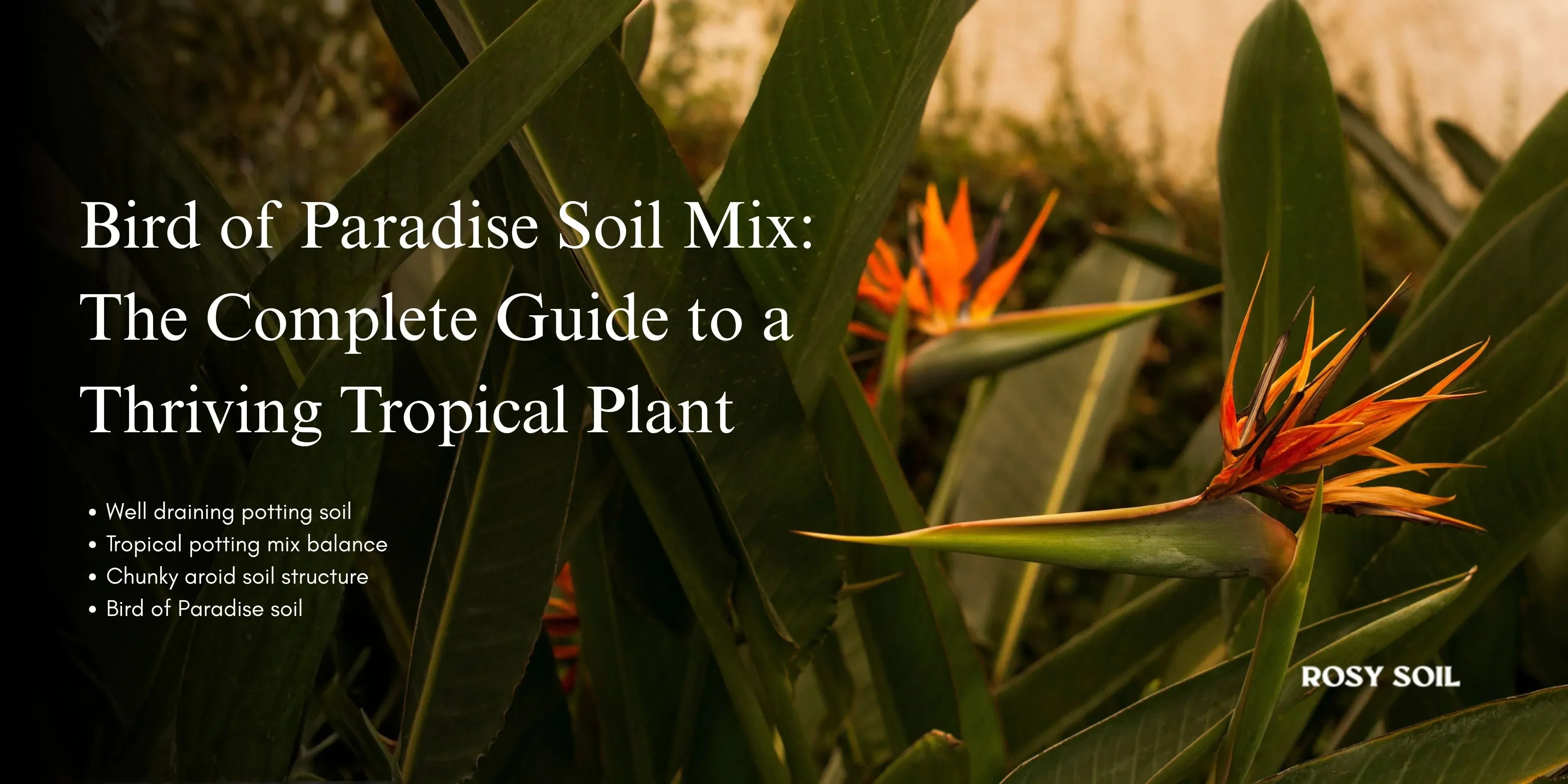
There is a reason Bird of Paradise (Strelitzia reginae) commands attention in every room it occupies. The broad, paddle-shaped leaves. The architectural height. The way it fills a corner like nothing else can. But behind that dramatic presence is a plant with very specific underground requirements, and most people never think about what is happening beneath the surface.
Soil is not just a medium that holds a plant upright. It is a living, functional system that controls how water moves, how roots breathe, how nutrients become available, and whether beneficial microbial activity can even take place. For Bird of Paradise, getting that system right is the difference between a plant that merely survives and one that genuinely thrives.
The Root System and Why It Changes Everything
Bird of Paradise develops a thick, fleshy root system, sometimes described as semi-succulent. These roots store water and nutrients, which is part of why the plant can tolerate some drought. But that same root structure makes them particularly vulnerable to prolonged saturation.
During the growing season, roots are actively expanding and absorbing nutrients. They need oxygen-rich soil to function properly. Dense or compacted potting mixes limit airflow to the roots, slowing growth even when light, water, and temperature are ideal.
This is why soil structure matters so much for Bird of Paradise. The roots are large, active, and need space, airflow, and a mix that supports both oxygen movement and moisture retention. A well-balanced tropical potting mix supports these processes and helps the plant grow consistently and healthily.
A well-structured tropical potting mix does not just drain well; it supports the biological processes inside the root zone.
What Soil Porosity Actually Does
Porosity refers to the balance of air spaces and water-holding capacity in soil. A healthy mix needs both.
-
Larger spaces between particles allow excess water to drain and let oxygen reach the roots.
-
Smaller spaces hold moisture, so the plant can stay hydrated between waterings.
For Bird of Paradise, balance is everything. If the soil drains too quickly, roots may not get enough water. If it holds too much moisture, it can stay wet for too long and lead to root rot.
For Bird of Paradise, the ideal soil mix typically includes around 60–70% drainage material and 30–40% organic matter. This balance allows roots to grow freely without staying waterlogged.
Breaking Down the Ideal Soil Ingredients

Bark Fines
Bark fines add structure and create air pockets in the soil. They help prevent compaction and allow roots to breathe, making them ideal for plants with large root systems.
Biochar
Biochar helps retain nutrients and provides a habitat for beneficial microbes. It also supports long-term soil structure and helps maintain a balanced growing environment over time.
Mycorrhizae
Mycorrhizae are beneficial fungi that form a relationship with plant roots, helping them absorb nutrients more efficiently. For nutrient-hungry plants like Bird of Paradise, this improves overall growth and resilience.
Worm Castings
Worm castings provide slow-release nutrients and support a healthy soil ecosystem. They improve nutrient availability without the risk of burning roots. Plus, they improve soil texture over time.
Compost
Compost adds organic matter, improves moisture retention, and supplies essential nutrients. High-quality compost also supports beneficial microbial activity in the soil.
Take the Rosy Soil Quiz to get a tailored recommendation based on your plant and environment. It takes under two minutes and removes the guesswork.
The Problem with Conventional Potting Mixes
Most potting soils on the market are built around peat moss, with perlite added for drainage. The problem is not the ingredients themselves; it is the formulation and what happens to it over time. Peat-heavy mixes compact significantly as the peat decomposes, gradually reducing the macropore space that Bird of Paradise roots depend on. What starts as a workable mix can become a dense, poorly draining block within a single growing season.
There is also the sustainability issue. Peat is harvested from ancient bogs that took thousands of years to form and store significant amounts of carbon. Disrupting them releases that carbon back into the atmosphere. As Rosy Soil outlines in their position on peat moss, the long-term cost of using peat is simply not worth it when better-performing, more sustainable alternatives exist.
The deeper issue is that conventional mixes are largely inert. They provide structure and some nutrition, but they do not actively support soil biology. A bag of standard potting soil will not contain the microbial diversity that makes nutrients bioavailable or the structural components that maintain pore space over time. For a plant like Bird of Paradise that stays in the same pot for years, that matters enormously.
How Soil pH Controls What Your Plant Can Actually Use
Bird of Paradise performs best in a pH range of 5.5 to 7.0. Within this range, the major nutrients, nitrogen, phosphorus, and potassium, along with micronutrients like iron and manganese, are at their most chemically available for root uptake.
Outside this range, nutrient lockout can occur. This is a situation where nutrients are physically present in the soil but chemically bound in forms the roots cannot absorb. A plant can be sitting in fertilised soil and still show deficiency symptoms simply because the pH is wrong. If your Bird of Paradise has pale or yellowing new leaves despite regular feeding, pH is worth investigating before assuming the soil lacks nutrients.
Quality aroid soil and tropical potting soil mixes are typically formulated within this pH window, which is one reason they outperform generic alternatives for tropical plants.
Rosy Soil's Aroid Mix: Built for Plants Like This
Bird of Paradise sits in an interesting category; it is tropical, has large fleshy roots, and demands excellent drainage. That profile aligns closely with aroid plants like Monstera, Philodendron, and Pothos, all of which thrive in an open, chunky, well-draining structure.
Rosy Soil's Aroid Mix is formulated with exactly these requirements in mind. It is peat-free, built with biochar for long-term soil health, and has the chunky, open texture that allows Bird of Paradise roots to breathe and expand without restriction. It maintains its structure over time rather than compacting down into a dense block, which means your plant is getting the same quality growing environment a year into its pot as it did on day one.
Signs Your Soil Is the Problem
-
Yellowing leaves: Often a sign of overwatering made worse by dense soil that retains too much moisture. If the soil feels wet more than five days after watering, the mix is too heavy for this plant.
-
Brown, crispy leaf edges: Can indicate underwatering or a mix that drains too aggressively. No new growth in spring or summer: Typically signals compacted soil, root-bound conditions, or a nutrient-depleted mix. Repotting with fresh aroid potting mix and pairing it with a gentle plant food will usually restart growth within a few weeks.
-
Roots growing out of drainage holes: Your plant has outgrown its container. Move up one pot size and replace the soil entirely with a fresh, well-draining tropical potting soil.
Conclusion
Bird of Paradise is not a difficult plant. It is a specific plant. And specific plants have non-negotiable requirements, drainage that actually works, a root zone that can breathe, stable pH, and soil that stays biologically active long after the initial repot.
Most people spend a lot of time getting the light right and dialling in a watering routine. All of that matters. But none of it fully compensates for soil that is too dense, too inert, or too depleted to support what the roots are actually trying to do.
Fix the soil, and everything else falls into place. Repot once with the right mix, and the plant has what it needs to work with for the next one to two years, no daily adjustments, no guessing, just a foundation that quietly does its job.
Your Bird of Paradise deserves better than whatever was left on the shelf at the garden center. Rosy Soil's Aroid Mix is peat-free, biochar-powered, and built for exactly the kind of thick, fleshy roots Bird of Paradise has no synthetics, no fillers, and no ingredients that compact and fail six months in.
Ready to upgrade your soil? Shop the Aroid Mix, the mix Bird of Paradise actually needs.