


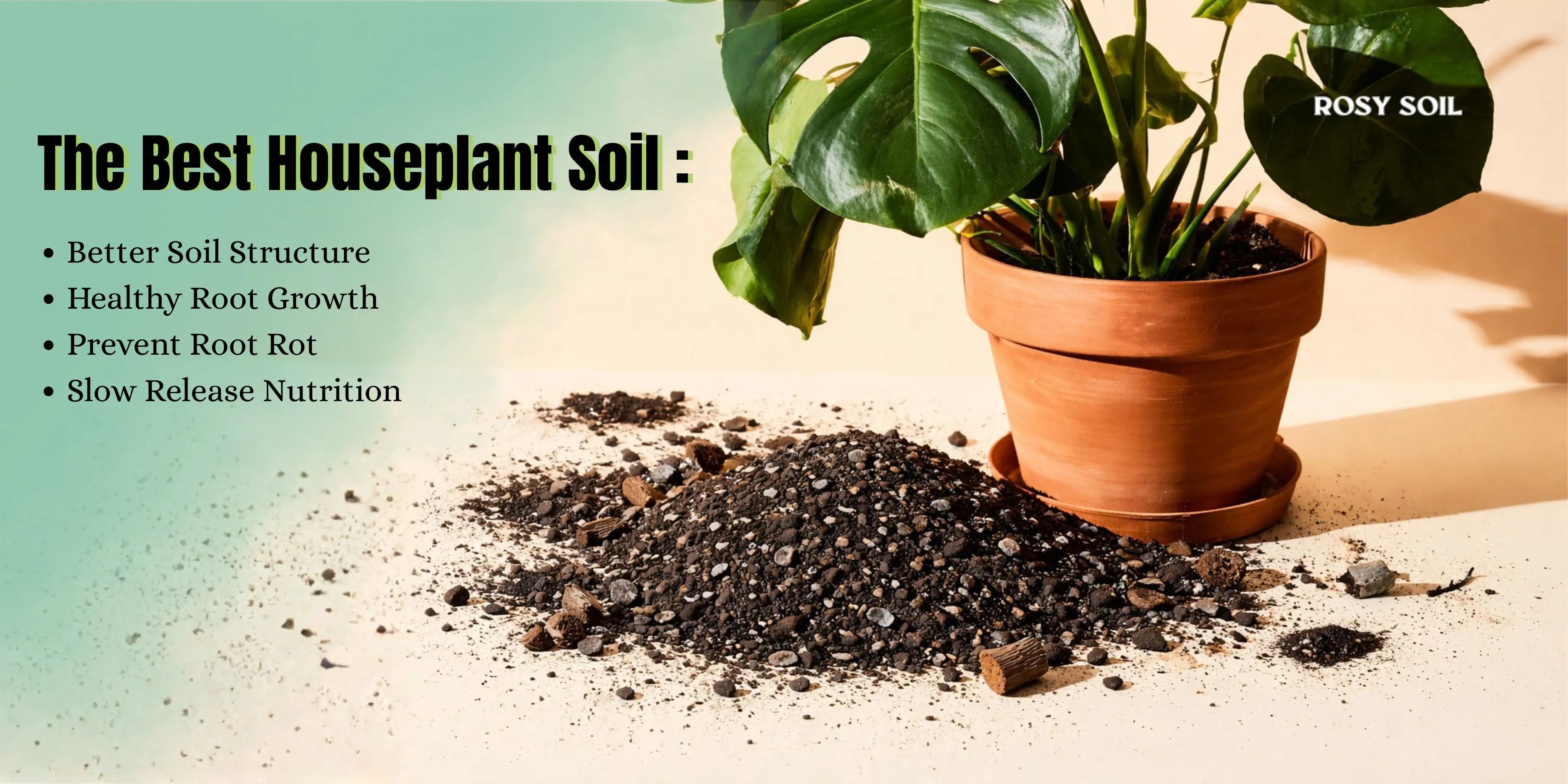
You are doing everything right, watering when the top inch is dry, rotating pots toward the light, and checking leaves for pests on schedule. And yet your plants still look a little off, pale, slow, or just never quite thriving the way they should.
Here is what most plant care guides never get around to telling you: the soil is almost always the variable nobody is watching closely enough.
Not the watering schedule. Not the humidity levels. The soil.
Most houseplant soil on the market is built around one priority, which is low production cost, not around what indoor plants actually need to perform. The result is a lot of bags that work adequately for the first few months, then quietly work against your plants for the rest of the year.
This guide covers what the best houseplant soil actually contains, what red flags to look for on the label, and why Rosy Soil's formula is built differently.
Why Most Potting Soil Quietly Fails Indoor Plants
Walk into any garden center, and every bag of potting soil looks roughly the same. Dark, fluffy, labeled with phrases like "premium blend" or "enriched formula." Most plant parents grab whatever is on the shelf without thinking twice.
The problem is structural. Standard potting mixes are engineered for moisture retention, which is what outdoor garden beds and vegetable plots need because sun and wind dry the soil quickly. Indoor plants live in containers in much lower-evaporation environments. When a moisture-retentive mix sits in a pot inside your home, it stays wet for too long. Roots that need both water and oxygen start to suffocate, and that oxygen-poor environment is exactly where root rot begins.
Then there is the compaction problem. Most conventional mixes rely heavily on peat moss as their structural base. Peat starts out light and airy, but it breaks down fast. It loses up to a third of its structure within the first year. What drained well in spring becomes dense and brick-like by fall. Water stops soaking in and starts running off the surface instead. Roots stop growing outward and start struggling.
Peat-based soil losing that much structure within a year means the indoor potting mix that worked great in January is choking your roots by summer. This is why experienced plant parents increasingly look for peat-free house plant soil, meaning a mix built on ingredients that stay structurally stable across multiple seasons rather than just the first few months out of the bag.
No Peat. No Synthetics. No Problems. That is the founding principle behind Rosy Soil, and it shapes every ingredient decision in the formula.

What the Best Houseplant Soil Actually Contains
The difference between a soil that works and one that quietly fails usually comes down to five specific ingredients. Here is what to look for and what each one actually does inside the pot.
Biochar: Structure That Does Not Break Down
Biochar is a carbon-rich, highly porous charcoal produced by heating organic material at high temperatures without oxygen. Unlike peat, which compacts and decomposes within months, biochar maintains its physical structure for years and sometimes centuries. That long-term stability is exactly what a container growing medium needs.
The internal surface area of biochar is what makes it stand apart. A single gram contains up to 1,400 square meters of internal pore space. That surface holds onto nutrients and hosts beneficial microorganisms right at the root zone, where plants can actually access them. Studies consistently show biochar improves nitrogen retention by 50 to 80 percent compared to conventional mixes, which means far less fertilizer is lost with every watering cycle.
Biochar is also carbon negative. Every bag of Rosy Soil actively removes CO2 from the atmosphere and locks it into stable form in the soil rather than releasing it. Rosy has captured over 800 metric tons of CO2 to date through its biochar-based formula. That is a number no conventional peat-based brand can match.
Rosy also offers a standalone Biochar Booster for plant parents who want to improve an existing mix without doing a full repot. It can be added directly to the current soil to improve aeration, nutrient retention, and structural stability over time.
Mycorrhizae: The Root Network Multiplier
Healthy soil is not just a growing medium. It is a living system. Mycorrhizal fungi are one of the most critical parts of that system. They form a symbiotic relationship with plant roots, extending a network of fungal threads far beyond the root ball and dramatically increasing the surface area a plant can draw nutrients and water from.
Research consistently shows that mycorrhizal networks can improve phosphorus uptake several times over under nutrient-limited conditions, which describes practically every houseplant growing in a container. The plant feeds sugars to the fungi, and the fungi return nutrients that the roots could not otherwise reach on their own. It is one of the most effective biological partnerships in all of plant science.
Most commercial indoor plant soil is completely sterile. No fungi, no bacteria, no biological activity of any kind. It holds a plant in place but does not support the kind of root development that produces genuinely healthy and vigorous growth. Rosy Soil includes mycorrhizae because that living component produces measurable, real results, not just a marketing bullet point.
Worm Castings: Slow Nutrition That Does Not Burn
Worm castings are nutrient-dense organic matter produced by worms processing organic material. They release nutrition gradually and in a plant-available form, without the salt buildup or root burn risk that comes with synthetic fertilizers.
Synthetic fertilizers flush out of the soil within two to three waterings. After that, the plant is nutritionally stranded unless you keep supplementing manually. Worm castings keep feeding for months. The microbial content in quality worm castings is ten to twenty times higher than ordinary compost, which creates a biologically active soil environment in the pot rather than just passive substrate sitting around the roots.
Seeing worm castings listed on a bag of potting soil for indoor plants is one of the clearest signals that the formula is built around actual plant performance.
Compost: Organic Foundation With Purpose
Good compost improves soil structure, buffers pH swings, and supports the broader microbial community that keeps soil biologically functional over time. Rosy uses compost made from verified green waste and wood waste, which are materials that would otherwise decompose in landfills and release methane and CO2. By redirecting those organics into the formula, Rosy sequesters that carbon instead of releasing it into the atmosphere. That is part of what makes every bag Earth Positive rather than just eco-labeled.
Pine Bark Fines and: Drainage That Holds Over Time

Pine bark fines create large, stable pore spaces inside the mix that persist even as other organic components break down. Unlike perlite, which is lightweight and floats to the surface during repeated waterings, bark fines stay integrated throughout the mix season after season.
What to Avoid When Choosing Houseplant Potting Soil
Reading a bag for what to avoid is just as valuable as reading it for what to look for. Here is what to pass on.
Peat moss is the lead ingredient. If peat leads the ingredient list, the soil will compact, become hydrophobic when it dries out, and lose structural integrity within the first year. It is also extracted from peatland ecosystems that took thousands of years to form and cannot be meaningfully replaced on any human timescale. Rosy Soil is completely peat-free by design, not by accident.
"Moisture control" formulas. This is marketing language for water retention. For the overwhelming majority of houseplants, including monstera, pothos, philodendron, snake plants, and peace lilies, moisture-retentive soil is exactly the wrong direction. These plants need clear wet-dry cycles. They do not benefit from perpetually damp roots, and sitting moisture is the primary cause of root rot in indoor containers.
Pre-loaded synthetic fertilizers. "Contains fertilizer" on the label sounds helpful until those water-soluble salts flush out within two to three months. After that, the soil is depleted, and the plant is nutritionally stranded. Rosy Soil uses worm castings and compost instead, which are nutrients that feed gradually for months rather than weeks.
Vague or missing ingredient lists. "Organic materials" or "proprietary blend" on a bag means the brand is not willing to tell you what is actually inside. Confidence in a formula means transparency about its ingredients. Rosy Soil lists everything clearly because there is nothing to hide.
Very cheap bags. A three-dollar bag is mostly peat and perlite. It will work for one season, then fail structurally. Over time, the cost of replacement plants and additional fertilizer far exceeds whatever premium you would have paid for a quality mix from the start.
Rosy Soil Houseplant Soil: What Is in the Bag and Why It Works
Rosy Soil's Houseplant Soil was formulated specifically for container growing indoors, not adapted from an outdoor formula with a new label. Every ingredient has a defined role, and every role is aimed at long-term plant health rather than short-term shelf appeal.
The formula includes: Biochar, Mycorrhizae, Worm Castings, Compost, and Pine Bark Fines.
What it delivers:
-
Nutrient-dense, living soil that feeds plants gradually over months
-
Excellent aeration and drainage that prevent overwatering problems
-
Long-term structural stability with no annual compaction cycle
-
Carbon negative impact with every bag sold
-
Pet-friendly and eco-friendly with no peat, synthetics, or plastics
-
Backed by science and patents, not just marketing claims
-
Resealable, plastic neutral packaging in four convenient sizes
Available sizes and coverage:
-
4 Quart covers 2 to 3 medium pots
-
8 Quart covers 4 to 6 medium pots
-
16 Quart covers 10 to 12 pots
-
32 Quart for larger collections.
Every plant has different needs. Use the Soil Quiz on the Rosy Soil website to get a personalized mix recommendation in about sixty seconds.
What Plants Does It Work For?
Rosy Soil Houseplant Soil is formulated for all common indoor plant types:
Foliage favorites: Monstera, Pothos, Philodendron, ZZ Plant, Rubber Plant, Chinese Evergreen, Calathea
Tropicals: Bird of Paradise, Alocasia, Parlor Palm, Areca Palm, Dumb Cane, Croton, Schefflera
Indoor flowering plants: Peace Lily, African Violet, Anthurium, Begonia, Kalanchoe
Ferns: Boston Fern, Maidenhair Fern, Asparagus Fern, Kimberly Queen Fern
Not sure which Rosy mix is right for your specific plant? Use the Soil Quiz on the Rosy Soil website to get a personalized match in about sixty seconds.
How Your Home Environment Affects Soil Performance
Most houseplant guides are written as though everyone lives in the same climate inside the same type of home. The reality is more nuanced, and it matters when choosing indoor plant soil.
In humid climates along the Gulf Coast, in Florida, or in the Pacific Northwest, indoor air holds more moisture, and soil in pots stays wet significantly longer. In those conditions, drainage and aeration matter even more than they would somewhere drier. The baseline risk of root rot is structurally higher, not because anyone is doing anything wrong, but because evaporation is simply slower indoors.
In dry climates across the Southwest, the Mountain West, or the Great Plains, the soil dries out faster. Plants in terracotta pots in Phoenix will need water more frequently than the same plants in ceramic pots in New Orleans, even with identical soil in both containers.
Seasonally, heating systems pull moisture from indoor air during winter and accelerate soil drying. Summer air conditioning slows evaporation and can leave soil damp longer than expected. The same watering routine will not perform identically year-round, regardless of how consistent you are.
A well-structured, fast-draining mix like Rosy Soil gives you that flexibility. Instead of fighting a soil that holds too much moisture regardless of what you do, you are working with a formula that adapts to your conditions and keeps roots healthy, whether you are in humid Florida or dry Arizona.
Related article: The Ultimate Plant & Soil Finder: What’s the Best Soil for Your Houseplants, Succulents, Herbs & More?
Pairing Houseplant Soil With the Right Plant Food
Even the best houseplant potting soil benefits from supplemental feeding over time, especially for fast-growing tropicals or plants that have been in the same container for more than a year without a soil refresh.
Rosy's Plant Food is formulated to work with the living biology already present in Rosy Soil rather than working around it. It feeds the microbial community as well as the plant directly, which means each application improves the soil's long-term function rather than just topping up a depleted container.
Unlike synthetic liquid fertilizers that deposit a salt load and flush out within a single watering cycle, Rosy Plant Food works gradually and consistently alongside the organic ingredients already doing their job in the mix.
Signs Your Current Indoor Plant Soil Is Working Against You
Soil does not announce when it has stopped performing. But it does leave clear signals. Here is what to watch for:
-
Water beads or runs off the surface rather than absorbing into the soil
-
The mix feels dense and heavy compared to when it was freshly poured
-
White or yellowish mineral crust forming on the soil surface from salt buildup
-
Growth has completely stalled despite adequate light and consistent watering
-
Leaves are yellowing from the base upward without any other obvious cause
-
The plant has been in the same container for more than a year without any soil refresh
If any of those apply, the soil is the most likely explanation. Repotting into fresh potting soil for indoor plants, specifically a peat-free biochar-based mix, is often the fastest single intervention available for a plant that has been quietly struggling without any obvious cause.
The Full Rosy Soil Range for Indoor Plant Parents
Rosy Soil makes a complete lineup of specialty mixes for every plant type you grow indoors.
Houseplant Soil is the all-purpose indoor formula for foliage plants, tropicals, herbs, ferns, and flowering houseplants.
Cactus and Succulent Soil is a fast-draining, sandy, peat-free mix for drought-tolerant plants that need quick dry-out between waterings.
Plant Food is an organic liquid feed that works with the living biology in your soil rather than against it.
Biochar Booster allows you to add biochar directly to any existing mix to improve aeration, nutrient retention, and structural stability without doing a full repot.
Rosy Soil is available at retailers nationwide. Use the Store Locator on the Rosy Soil website to find the nearest stockist. Or order online with free shipping on orders over $75.
Good for Your Plants. Good for the Planet.
Rosy Soil is not just a better formula. It is a different philosophy about what potting soil should be and what it should do beyond keeping plants alive in a container.
Most conventional mixes extract peat from wetland ecosystems that took thousands of years to form, release stored carbon in the process, and leave behind synthetic residue that accumulates in container soil over time. Rosy does the opposite on every count.
Every bag is carbon negative. The biochar locks carbon into a stable form in the soil rather than releasing it into the atmosphere. Over 800 metric tons of CO2 captured and counting. The packaging is plastic neutral.
The ingredients are sustainably sourced, peat-free, and completely synthetic-free. The formula is patent-backed and has been featured in Architectural Digest, Better Homes and Gardens, Real Simple, and Domino Magazine.
Growing better plants and doing less environmental damage are not competing goals. Rosy Soil is proof that they can be the same goal.
Learn more at the Our Mission page on rosysoil.com.
Conclusion
The best houseplant soil does five things consistently. It drains well, it aerates the root zone, it feeds plants slowly over time, it stays structurally stable across multiple seasons, and it supports the living biology that makes everything else possible. Most bags on the shelf manage one of those. Rosy Soil manages all five.
If your plants have been struggling despite good care, the soil is the first variable worth examining and the highest-leverage one you can change. A single repot into a quality mix can produce visible results faster than adjusting light, watering schedules, or humidity levels ever will.
Your plants are ready for better soil. Shop Rosy Soil Houseplant Soil starting at $19.99 - free shipping on orders over $75. Shop Now.